
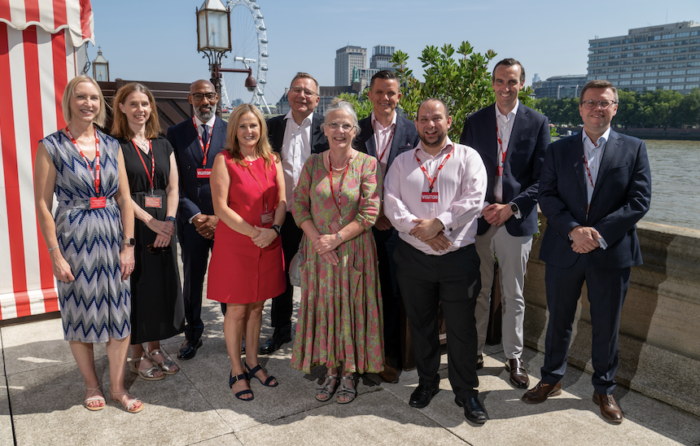

The Mayfield Review team “absolutely gets” what the group income protection sector does and also wants to explore what more it can do.
CLICK HERE TO DOWNLOAD A FULL PDF OF THIS GROUP RISK ROUND TABLE REPORT
Katharine Moxham, the spokesperson for industry body Group Risk Development (Grid), made this assertion at a recent Corporate Adviser round table event, titled ‘Workplace benefits under pressure: balancing costs, care and outcomes.’
Officially known as the Keep Britain Working Review and chaired by former John Lewis chief Sir Charlie Mayfield, the Review was launched by the UK government in 2024 and looks to tackle issues related to chronic workplace absence.
Panellists suggested that the Review’s final recommendations, published in November last year, should give the sector a huge opportunity to design products for SMEs to help them manage absence, but also pointed out that the Review could not do everything for them, with some product and distribution challenges for the sector still to resolve.
Moxham said that the Review doesn’t mean that group income protection will be recommended as the sole solution, or employers will end up being compelled to buy these insurance products.
She said: “An employer has lots of things in their kit bag. Group income protection is one of them. Some employers will use other means, and I think the Review doesn’t want to point anyone particularly to one thing or another. But there is merit in exploring further with them how we can support things.”
Panellists were also realistic about what might be recommended.
Canada Life UK head of product and proposition strategy Chris Morgan said: “They will not do our job for us. But there’s a good chance that our products will be endorsed or we will be able to design our products so that they meet the needs that the government policy will likely set out.
“It is a fantastic opportunity for us to present to a small business that income protection, packaged well and with a few tweaks, can provide a simple solution for an employer to help manage sickness absence. The reality is that small companies just don’t have the resources. They don’t have the capability. They don’t have the knowledge to manage it.”
Rally behind Mayfield
Panellists called on the industry to rally behind the Review. David Williams, head of group risk at Everywhen, said: “As an industry, we have to rally behind it because it’s a significant piece of research, which could really change how we work.”
He added: “The reality is that employers will be encouraged, at the very least, to better support their employees, to stay in work and return to work. They will have a choice between insurance and non-insurance conventional health services. I think that the costs in that comparison will be much more obvious in the future. We are moving away from a world where benefits are bought in silos.”
Others said the Review provided a huge opportunity to keep insurance on the agenda, especially as the surge of interest in the product post-Covid has begun to fade.
Terry Froment, head of group risk at Brown and Brown said: “It’s keeping it on the agenda. We had the Covid bubble. Everyone realised that we’re mortal and we’re going to get sick. There was this great surge of interest in what we did, which is just starting to lose momentum because we’re four or five years past it now. We’ve all gone back to being invincible and never going to die. Keep Britain Working has come along at just the right time to keep [workplace protection] on the agenda.”
Government help
Morgan stressed that while the Review panel is doing important work, clear recommendations to employers are yet to be forthcoming.
“Neither has (the Review) talked about how they’re going to compel or encourage employers who are not already doing this stuff to do it. We’re still at the early stages, but from what I’m seeing, I think it’s really positive for our market, but we will need to step up to that in terms of product development and distribution. In terms of distribution the government isn’t going to solve that problem.
“We still need to be there for companies which need help managing sickness absence. And our products can potentially provide a solution for that. But we need to find new ways of reaching new customers at greater scale than we do now.”
Titan Wealth corporate benefits consultant Ian Lewer also urged continued industry focus on this issue, particularly given there is now a new prime minister in charge. He said: “We’ve got the spotlight, but it’s very easy for that to move on, especially with a new government. Things can change and priorities move. If you’re not careful, you’re the one that gets dumped by the wayside, when something new, jazzy and interesting comes along.”
Some advisers also hold out hopes of a snowball effect among smaller employers. AJ Gallagher senior health and risk consultant Amanda Gill said: “For something such as income protection or absence support, if one SME is doing it, then the competitor will be driven to do it. It’s a massive retention tool, so that will probably drive more interest within different industries. There’s a lot of the feedback we get from bigger clients saying: ‘Well, our competitors are offering this, we’re losing people because of this. So, we need to up our game’.”
Adviser opportunity
Morgan expressed that there was “definitely a role for us to help an employer manage the broader sickness absence question, which the product does, by and large at the moment, though there are still some gaps.”
He continued: “The likelihood is those recommendations are not going to say to each individual employer, you must do this. What they’re going to say is ‘we want you to encourage this kind of outcome’. That will give enough flexibility to individual employers to do slightly different things relevant to their workforce. For advisers, the nature of the advice you provide will probably change when you get into sickness absence proper and business productivity rather than just employee benefits.”
It was asked at the round table whether the government needed to do more, potentially even providing tax breaks or auto-enrolment, but Moxham conceded that this was very unlikely to happen.
Price point
A recurring theme for the round table was price sensitivity in this market. Williams said that while there was opportunity for more SMEs to buy protection, it needs to be “at a decent price point” because of the economic challenges employers face now. “In a way, the timing is unlucky because it suggests putting the employer right in the middle of the whole employee health issue, just at a time when employers don’t have a lot of cash,” he said.
MetLife UK deputy CEO Adrian Matthews also claimed that an absence management tool could hold great appeal.
“This tool is for particularly the 20 per cent of businesses who don’t monitor their absence whatsoever. The other 80 per cent will probably say I don’t want another virtual GP. I’ve already got an all-singing, all-dancing one. But Mayfield will put the employer in the middle, but also put the onus on employees to accept responsibility as well.”
There was also a call for more data around outcomes, with both providers and advisers sharing more information with employers. Williams said: “Obviously with the added benefits of digital usage, we can track who’s registered and used services like the virtual GP. But can we also track the outcomes of this, so if someone’s had a mental health episode and used this service what was the outcome? We know they might have made six calls, but are we tracking the actual health outcomes?”
Also at the round table, it was explored how confidentiality may stymie some data sources. Matthews said: “If you have an an early intervention service that signposts people towards various early intervention services this should have a positive impact. But it’s hard to get the data on these end results because of confidentiality around who’s called the EAP.”
Gill said : “It would be good to get data where people have contacted the EAP. And then at the end of their sessions find out whether they are still in work.”
Communicating better outcomes
There was also a lot of discussion at the round table about the use of data and technology, and how this could be applied to improve understanding and communication.
YuLife chief revenue officer Keith Bale said it was important to start with key outcomes that employers want to see. “As a first step, you could show the value employers have seen that year, via an annual value statement. Let’s say if they’ve spent five thousand pounds and got back a return of eight thousand pounds. If I’m an employer and I see that, I go ‘great, that’s that’s a good return’. Why would I not continue?”
Froment suggested that insurers might commit to sending a value statement along with a renewal and telling employers the engagement they had. Matthews added that this already occurs with certain sized companies, but suggested that this is a problem if there is a company of 10 people and three use an EAP counselling service, as people could easily be identified.
Froment suggested aggregating data to tell employers the benefit that companies of their size are getting. Bale suggested there was nothing to stop an adviser doing so as well.
He said: “You could aggregate it for your book and you could say, I know the value of an EAP. Or you could work with MetLife and Canada Life. You could find the value of an EAP, the return on investment, and you could do it across your book and say, we’re going to have our own value statement that goes out to our employers. It’s not just the insurer. It’s on both insurers and advisers. You do it for the large employers. There has to be an easy pathway for SMEs.”