
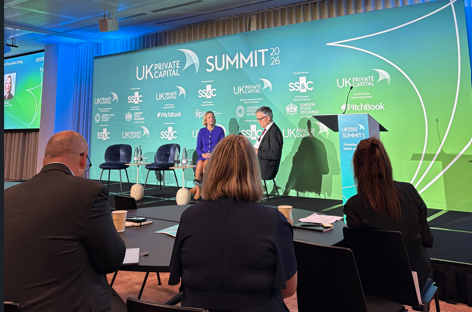

Pension industry figures urged a fundamental rethink to fees in private markets and questioned the efficacy of government initiatives such as the Mansion House Accord at a pensions summit hosted by UK Private Capital, the main trade association for the UK’s private capital industry.
Hannah Gurga, director general of the Association of British Insurers, urged for greater engagement with industry stakeholders and a willingness to charge higher fees when it came to private markets.
“How do we shift perspective and move from you know the cost is king culture to a focus on overall value?,” she says.
“We have seen progress, but it’s going to be incumbent on us to actually make sure that we are bringing that whole ecosystem on the journey. We also need to see greater regulatory alignment between the treatments of the performance fees under the charge cap. We’re making progress, but that is also going to be really critical.”
On the point of the charge cap for DC schemes investing in private assets, Anne Glover, chief executive at Amadeus Capital, went further, arguing that it should be scrapped entirely as schemes were consistently well under it and ultimately the only important metric should be returns for members.
She also questioned the approach of the Mansion House Accord, the voluntary arrangement in which pension schemes agree to commit capital to domestic private markets, a pledge which may become mandatory under legislation passed within the Pension Schemes Act this year.
Glover says: “(The Accord) basically measures volume. It’s deployed capital. They don’t measure returns. There isn’t anywhere in those accords or compacts a statement about net returns. And in the end, you ask what is success, and for me, success is returns.”
A recent report from UK Private Capital also found that despite signs that pension funds intend to broaden their asset allocations, and some DC schemes having established new teams and structures for investment, evidence to-date indicates that actual allocations from default funds into private markets remain very low.
The most recent update of Mansion House Compact signatories showed that as of February 2025, only 0.6 per cent of assets under management by signatories were allocated to private markets, while a UK Private Capital survey of VC and growth equity firms could only identify two legally binding commitments.
Liz Fernando, chief investment officer at Nest, pointed out that in its own approach the pension scheme does not pay out carried interest or performance fees.
“We’ve shown what you can do at scale. If you’ve got large sums of money to commit, you can afford to negotiate. You need your partners to step up and to recognize that when you’re deploying a £1bn fund, the economics are going to be very, very different to when you’re deploying a £20bn fund, and that needs to be recognized.”
Fernando also disclosed that Nest has currently got about 20 per cent in private markets today, above the pledges within the Mansion House Accord. Of this, Nest has approximately 5 per cent in private equity, and the rest of the allocation is more broadly spread across real estate, infrastructure, private credit, and a “small but growing” timber allocation.
Nest is anticipated to have £100 billion in assets by 2030.