Corporate Adviser
  • Content Hubs
  • Magazine
  • Alerts
  • Events
  • Video
    • Master Trust Conference 2024 videos
  • Research & Guides
  • About
  • Contact
  • Home
  • News
  • In Depth
  • Profile
  • Pensions
    • Auto-enrolment
    • DB
    • DC
    • Defaults
    • Investment
    • Master Trusts
    • Sipps & SSAS
    • Taxation
  • Group Risk
    • Group Life
    • Group IP
    • Group CIC
    • Mental Health
    • Rehab
    • Wellbeing
  • Healthcare
    • Musculoskeletal
    • Mental Health
    • IPT
    • Wellbeing
    • Trusts
    • Cash Plans
  • Wellbeing
    • Mental Health
    • Health & Wellbeing
    • Financial resilience
  • ESG
No Result
View All Result
Corporate Adviser
No Result
View All Result

Pension funds’ UK shareholdings a tenth of 1992 level

by Corporate Adviser
September 10, 2015
Equiniti research

Equiniti research

Share on FacebookShare on TwitterShare on LinkedInShare on Pinterest

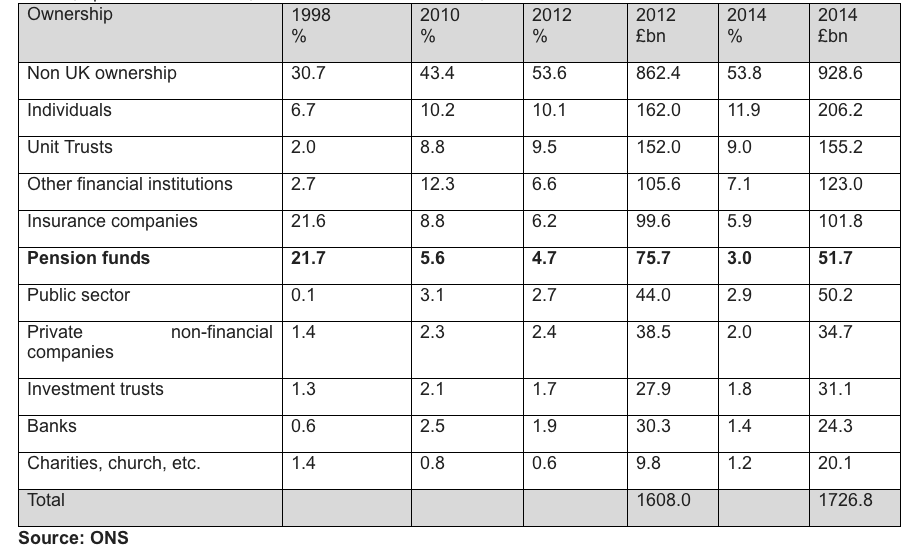
Shares fell from 4.7 per cent in 2012 to 3 per cent in 2014, the lowest ever recorded and a drop in value of £24bn from £75.7 bn in 2012 to £51.7bn in 2014.

The ONS report reveals that in 1963, the proportion of shares held by pension funds was 6 per cent, growing to a high of 32 per cent in 1992. Since then pensions funds’ holdings have fallen.

The split in ownership by pensions funds between FTSE 100 and other UK quoted companies has also dropped, from 85 per cent in 2012 to 83 per cent in 2014. Only individual investors had a much wider split of investments with 38.9 per cent in the broader market, up from 28 per cent in 2012, and 61.1 per cent in the FTSE 100, down from 72 per cent in the 2012.

Equiniti managing director, data solutions Duncan Watson says: “Pension funds are side stepping volatility, diversifying and de-risking. Mature schemes are looking for exposure to gilts and fixed interest while others are reacting to market highs by crystallising gains.  Schemes are also taking advantage of buy-out opportunities. Behind this trend sits the need to protect funding positions by finding lower risk strategies and absolute returns.

“The fall in ownership also illustrates the difficulties schemes face in participating in the government’s call to invest in long term infrastructure products; it is little surprise that these are largely the reserve of public sector schemes. 

“The switch to gilts comes despite the Bank of England’s quantitative easing programme. The BoE has bought approximately £375 billion of gilts under QE since start of the programme in 2009”

 

Corporate Adviser Special Report

REQUEST YOUR COPY

Most Popular

  • WTW to acquire Cushon

  • Mercer UK on track for £25bn megafund target ahead of 2030 deadline

  • Targeted support-ready workplace digital adviser launches

  • FCA confirms targeted support plans will not extend to TPR-regulated schemes

  • FCA unveils targeted support framework for savers

  • In focus: Green light for retirement-only CDC

Corporate Adviser

© 2017-2024 Definite Article Media Limited. Design by 71 Media Limited.

  • About
  • Advertise
  • Privacy policy
  • T&Cs
  • Contact

Follow Us

X
No Result
View All Result
  • Home
  • News
  • In Depth
  • Profile
  • Pensions
    • Auto-enrolment
    • DB
    • DC
    • Defaults
    • Investment
    • Master Trusts
    • Sipps & SSAS
    • Taxation
  • Group Risk
    • Group Life
    • Group IP
    • Group CIC
    • Mental Health
    • Rehab
    • Wellbeing
  • Healthcare
    • Musculoskeletal
    • Mental Health
    • IPT
    • Wellbeing
    • Trusts
    • Cash Plans
  • Wellbeing
    • Mental Health
    • Health & Wellbeing
    • Financial resilience
  • ESG

No Result
View All Result
  • Home
  • News
  • In Depth
  • Profile
  • Pensions
    • Auto-enrolment
    • DB
    • DC
    • Defaults
    • Investment
    • Master Trusts
    • Sipps & SSAS
    • Taxation
  • Group Risk
    • Group Life
    • Group IP
    • Group CIC
    • Mental Health
    • Rehab
    • Wellbeing
  • Healthcare
    • Musculoskeletal
    • Mental Health
    • IPT
    • Wellbeing
    • Trusts
    • Cash Plans
  • Wellbeing
    • Mental Health
    • Health & Wellbeing
    • Financial resilience
  • ESG

This website uses cookies. By continuing to use this website you are giving consent to cookies being used. Visit our Privacy and Cookie Policy.