
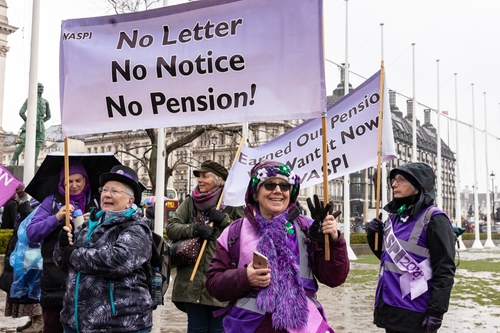

The Government has denied compensation for Women Against State Pension Inequality (WASPI) women for a second time, with secretary of state for Work and Pensions Pat McFadden telling Parliament that the majority of 1950s‑born women “would not have read and recalled the contents of an unsolicited pensions letter,” even if it had been sent earlier.
Waspi chair Angela Madden immediately condemned the decision, saying: “Ministers have demonstrated their utter contempt for 1950s-born women, for Parliament and for the Parliamentary Ombudsman. The Government has kicked the can down the road for months, only to arrive at exactly the same conclusion it has always wanted. This is a disgraceful political choice by a small group of very powerful people who have decided the harm and injustice suffered by millions of ordinary women simply does not matter.”
She added that Waspi is “taking legal advice, and all options remain on the table” and is prepared to pursue the matter “in Parliament and in the courts to secure the justice that has been so shamefully denied.”
McFadden’s statement comes after a full review of historical evidence, including a 2007 report on the effectiveness of automatic pension forecast letters, which concluded that they “only had a negligible impact on pension knowledge and planning” and were subsequently discontinued.
He acknowledged and apologised on behalf of the Government that individual letters about changes to the state pension age could have been sent earlier. But he also said that women “did not suffer any direct financial loss from the delay,” and that an earlier letter would have been unlikely to change what the majority of women already knew about their state pension age.
McFadden explained that establishing a compensation scheme would be impractical as it would be impossible to verify who genuinely did not know their state pension age and whether they would have read a letter and if they would have acted differently. He said a flat-rate scheme costing up to £10.3 billion “would simply not be right or fair,” given that the vast majority were already aware of the changes.
McFadden also said that the review only focuses on the communication of changes to the state pension age and not the merits of past policy decisions. He said that the department and the Ombudsman will continue developing an action plan to improve pension communications in the future.
He mentioned ongoing efforts to support pensioners which include campaigns to increase pension credit uptake, investment in the NHS, and the protection of the triple lock, which will see the state pension rise by up to £575 this year and overall spending reach more than £30 billion higher by the end of the Parliament compared to 2024/25.