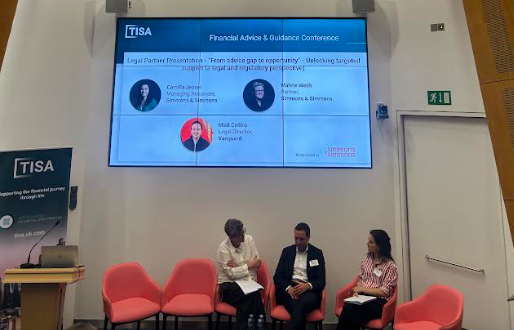
The rollout of targeted support can be a significant driving factor in closing the current financial advice gap in the UK, according to Matt Collins, a legal director at Vanguard.
Having gone live this month, targeted support is intended to sit between guidance and full regulated advice and will allow firms to provide suggestions to groups of consumers who share common characteristics, particularly in relation to pensions and retail investments. The aim is to give more people access to meaningful support when making long-term financial decisions.
Collins made the remarks at The Investing and Saving Alliance’s (TISA) Financial Advice and Guidance Conference.
He says: “Whether the advice gap is completely closed or not a really positive caveat is that targeted support is going to make it materially narrower and shallower, particularly in five years and with simple advice being integrated ads well. I’m optimistic.”
Research by TISA and the University of Nottingham also showed that targeted support is most effective when tailored to consumers’ attitudes, increasing investment by at least 30 per cent more than that achieved by demographic-based targeted support. The research was conducted in conjunction with Barclays, Lloyds Banking Group, and Vanguard.
John Gathergood, professor of financial economics at the University of Nottingham, also noted an exception to an ongoing UK reluctance to invest in markets is through retirement savings.
He says: “Auto enrolment has been a very powerful way to get people in DC funds without realizing the vast majority of old individuals are not very engaged. You may have an individual on the street saying they don’t want to invest when they already have money in a global fund (through retirement savings).”
The research also found that attitudinal targeted support increased investing by 31 per cent for women (compared to 16 per cent for men), and 53 per cent for first time investors (versus 14 per cent existing).
When asked by Corporate Adviser on whether targeted support will be able to fully integrate the moral and ESG positions of prospective investors, Gathergood says: “There may well be the case that people are held back from investing because they perceive that investing necessarily buys things that are contrary to their ESG values and preferences.
“Maybe you can uncover those by asking preferential questions during targeted support, and then recommend people towards those flavours of (ESG) funds.”
Overall, consumers who received targeted support were 53 per cent more likely to invest instead of holding savings in cash, compared with having received no such advice.