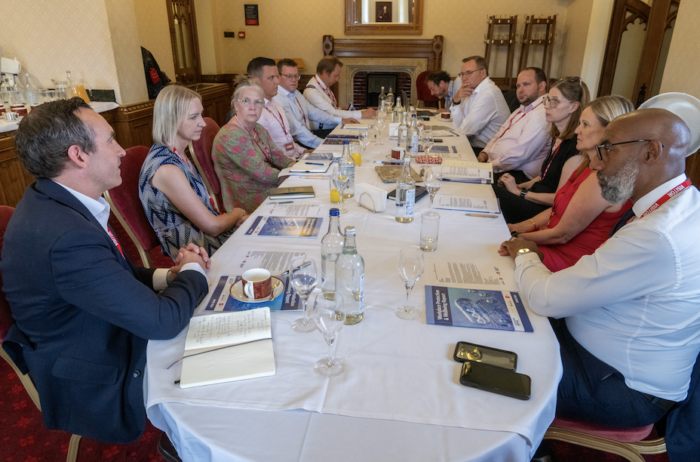
The group protection and wellbeing sector has been challenged to find ways to innovate in an environment where employers are incredibly cost conscious.
TO DOWNLOAD A FULL COPY OF THIS ROUND TABLE REPORT CLICK HERE
Advisers believe that there needs to be a huge push on employer understanding of the value insurance can deliver. But they also admitted that their practical experience showed how difficult it could be to overcome such misunderstandings.
YuLife chief revenue officer Keith Bale, noting the headwinds facing employers over the minimum wage and national insurance increases, stressed the importance of advisers and insurers getting the story and the data across about how beneficial group income protection can be in a “really crisp way”, because “every pound matters to an employer right now”.
Cutting absence – a business imperative
MetLife UK deputy CEO Adrian Matthews said: “The average employee is now taking almost 10 days off a year, making for around £200bn in absence costs overall. That’s costing everyone in the country. And that’s before we start talking about presenteeism.
“Absence is often talked about as a HR problem, but it’s not. This is a business imperative. It’s costing businesses hundreds of thousands of pounds every day. We have a chance of moving things. We’re very good at paying claims, and we’ve got to move it towards prevention.”
There were concerns about employers not understanding income protection and indeed how costs could be held down.
Caroline Katnoria, senior consultant for risk & healthcare at PIB Employee Benefits, said: “Some employers think that income protection should be paid to termination age. But as we know, you can have a limited payment term. Employers also don’t see all the other added benefits with the early intervention services and rehab, though it is an affordability issue as well.”
Titan Wealth corporate benefits consultant Ian Lewer also raised the issue that some employers think GIP is about “encouraging people to take time off”.
“Yet we know it prevents people from taking time off and in many cases reduces absences. I’ve seen that with my own eyes, but I can tell that to some clients until I’m blue in the face and they won’t believe me. They say: ‘No, if I have GIP, more people will take time off because they think they are going to get paid.’”
He also argued that it was also important for the government and the legislature to better understand the product.
Katharine Moxham, the spokesperson for industry body Group Risk Development, suggested that policymakers do now “get what we do and see the benefit of it, particularly for smaller employers” echoing her position on the Mayfield Review.
Brown and Brown head of group risk Terry Froment suggested that even when the client understands this product, “you still have this struggle of communicating that the real return on investment on income protection is not the amount of people that go to claim. It’s the amount of people that don’t. How do you present that back to a finance director? You’ve spent money on this and everyone is still at work.”
David Williams, head of group risk at Everywhen described where a client might take out critical illness over income protection because “it’s a list of illnesses which have to be visible to claim to get the money”.
He added: “That is missing the point. It’s not just about having the money. The money is the support, but there’s all the other stuff about prevention but that is the challenge we face.”
14 weeks is too late
Froment also pointed out another related misconception. He said: “I’ll still get called at 14 weeks of absence with the employer saying we’ve had somebody off for 14 weeks, and asking don’t they have this protection thing. They think that employees have to be off for three months before they contact us. It doesn’t matter how many times we ask them to inform us as early as possible about staff absences to make the most of the early intervention tools and support services. In the nicest sense, we don’t work like other insurance. It goes against the grain of everyone’s experiences of the wider insurance industry.”
AJ Gallagher’s senior health and risk consultant Amanda Gill said: “When we discuss absence with clients that don’t have income protection, smaller companies say: ‘It’s fine. It’s just still on the payroll and we’ll just manage it’. It is the value adds and the early intervention and the rehab and all that support that needs to really come to the surface more.”
Isio Workplace health and wellbeing senior manager Kevin Grant said that communication is key to selling income protection, but there is difficulty in getting that ROI. “Information is easier in group CI or group life because it pays out. It’s tangible. But with income protection, it’s less tangible. We’re trying to convince the finance director about the value of having it in the first place. Well, how do you do that? Maybe we need to get better at being able to communicate that to employers.”
Katnoria asked: “Could they [insurers] give advisers an example of the cost of all the added value benefits, as if you took it out separately? If you break down all the costs of the EAP, the mental health counselling, that would really help us to sell the product.”
Matthews added: “For GIP, we absolutely want people to engage with early intervention tools. If you were to take the early intervention out, you’re missing the point of GIP.”
He also pointed out that if you started unbundling costs it opens up employees and employers to P11D charges.
Measuring engagement
Froment also suggested that people may not engage with things they don’t pay for.
Bale added a twist on that: “You don’t value what you don’t engage in. What I see is if employers or their employees don’t engage with the benefit or the extra services added by the insurers, then the churn rate does go up significantly. We’ve got a traffic light system. If they’re not engaged in those benefits straight away, then we can look at ways to address this. We can start to unlock that by giving more information on usage that employees have had. Often this can make a real difference.”
Winning over financial directors
Gill said: “There is a role for advisers to make sense of all the value adds, because some HR departments are limited in their time and what they can manage because their costs have been cut too. If you’ve got income protection with one provider, life with another, and PMI with another, it’s hard to see the wood for the trees. As advisers we can sit down with clients and discuss what their aims are. Maybe it is not about all products for all employees. It is about building a programme and clearing a lot of the noise away.”
Lewer explained that a priority was helping HR people who don’t have benefits backgrounds, as firms are being paid to provide this support. There was talk of going beyond the HR manager in terms of absence management.
Bale said technology will help. “Rather than relying on line managers to flag illness, we’ve got AI coming now. This is going to help us all. If we make smart use of that, you can then use the technology to do the job for you. Engage people, get those flags built in, and the whole thing becomes a lot more seamless. A big part of our answer comes in there.”
Grant says: “It would be great if we could show some kind of journey for somebody who’s gone off sick, compared to if they engaged in the intervention services.
“What does that look like for an employer if they did engage and what if they didn’t, what was the outcome? What was the actual spend? What if you had to get cover, get somebody else to do the extra work that this person couldn’t do? That would be an easier sell to a finance director in terms of showing that journey. Once you have that you can see the tangible benefit.”
Williams said: “It’s often the indirect absence costs that get missed. The direct cost is paying sick pay, that’s quite obvious. But you’ve also got to consider people coming in to cover that role, or the extra hours the HR team are doing to support a return to work. This interaction is often missed with an absence.
Gill added that there needed to be more frequent engagement than just at renewal. “Say you’ve got someone new in your HR team. Shall we get MetLife to have a chat with you about what the services are? Should we get the EAP provider in to run through that with you? It’s this engagement that’s needed, outside of those peak periods.”
Bale also noted the benefits of a champion within the business and how to help them. “When you find a champion at the customer end, who believes in the product and wants to get it conveyed to their employees, then you make it really easy for them. Be that technology, be that however you do it, you make it very easy for them. You give them the tools to be able to disseminate that on a regular, ongoing basis and engage their employees.”
Katnoria added: “Some of the insurers have introduced claims relationship managers for the bigger clients as well. That works really well with my clients where they can have regular meetings once a month where we run through all the claims, absences and everything. That really helps the HR team. She pointed out that issues around mental health are “through the roof” but said it’s clearly demonstrated that people are returning to work quite quickly by using these support services. This contrasts to those who don’t have
this support.
Those at the events agreed that evidencing this helps when having conversations with employers, and also when talking to governments. Moxham said: “This is vital for discussions with policy makers. We say we get people back to work and they reply, show us. What are the numbers? But we are now demonstrating what we can do as an industry”